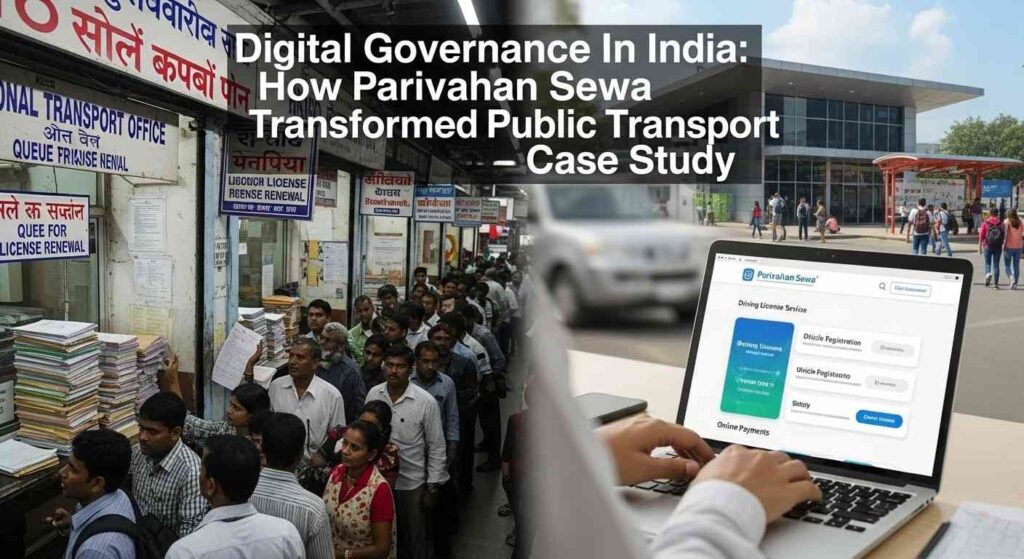
From State Chaos to One Digital Road
In India, public transport once moved slowly. Rules changed by state. Files stayed on desks. People waited in lines. This system had many inefficiencies. Each region used state-specific systems. There was no single view.
The change began with Parivahan Sewa, led by the Ministry of Road Transport and Highways (MoRTH). The shift focused on modernization and consolidation. A strong digital platform replaced paper work.
One Portal, Daily Use – Parivahan
The official site parivahan and the mParivahan mobile app became daily tools. Many people use them without help. Integration with Aadhaar, DigiLocker, and payment gateways made work smooth. Payments are safe. Records are trusted.
This national platform now supports streamlining operations, time savings, and resource savings. It feels simple. It feels reliable.
Driving License Services Without Stress
Driving License Services saw the biggest relief. Now, learner’s license, permanent driving license, and online renewal are easy. Users see status tracking, real-time updates, and application progress online.
In many places, online tests and learner’s license tests reduced travel. Fewer visits mean less cost. Parivahan removed fear from the process.
Vehicle Registration Goes Digital First
Vehicle Registration followed the same path. New registration is fast. Digital registration reduced minimal paperwork needs. Ownership transfer, vehicle ownership, and fancy number booking are online.
Users can choose premium numbers and preferred registration numbers with clarity.
E-Challan and Fair Enforcement
The E-Challan System changed traffic violation management. Drivers check traffic fines using vehicle number or challan number. Details show violation details and payment status.
Enforcement integration with traffic police systems improved trust. E-challans allow faster resolution of violations. Traffic management improved. Bribery limitation became real.
Permits, Taxes, and Compliance
Under Permits and Taxes, users access national permits and state permits. Commercial vehicle permits support goods transport and passenger transport. Road tax payments and online tax payment are clear. Payment history stays visible.
Fitness certificates and vehicle fitness certification improved regulation adherence. This helped operators and gave strong commercial transport support. Permit simplification and tax simplification improved compliance improvement.
Vehicle Information in Seconds
Vehicle Information Services give instant checks. Users can see RC details, registration certificate, insurance details, and fitness status. Vehicle numbers, hypothecation removal, and vehicle loans appear clearly.
Mobile Proof and Paperless Trust
The mParivahan App offers mobile access on Android and iOS devices. Virtual documents and digital copies replace paper. Driving license and insurance can be done on the phone.
QR code verification, authorities’ verification, and QR scans reduced road arguments. This is real paperless transactions.
Contactless Services for Daily Life
Contactless Services and Faceless Services changed behavior. Document upload, DigiLocker verification, and faceless approvals reduced in-person interactions. This lowered corruption reduction and service delays.
With 24/7 access, home access, and on-the-go access, people gained time efficiency. Long queues faded. Bureaucratic hurdles reduced.
How People Use Parivahan Sewa
Steps are simple. Visit portal, download app, register, login with mobile number and email. Select service, upload documents, sometimes manual uploads, then verification.
Users make payments for fees and taxes via UPI, net banking, or cards. Track progress, check application status, and see real-time monitoring on a user-friendly interface. It works for tech-savvy users and novice users.
Evidence and Inclusion View
Studies using a mixed-methods approach show gains in public service delivery.
- Integration with the Aadhaar program enabled Aadhaar-linked bank accounts, direct benefit transfer (DBT), cooking gas, LPG, and other essential services. This reduced duplicate claims, ensured genuine recipients, and used biometric verification to limit subsidy leakages.
- Links with Public Distribution System (PDS) improved food grains distribution and beneficiary inclusion in rural areas.
- Strong data privacy, data security, protection of biometric data and demographic data, plus encryption against data breaches, identity theft, and cyber threats remain vital protective measures.
- On finance, financial inclusion expanded for the unbanked population through Jan Dhan accounts, improving banking access for low-income individuals.
Results include better social welfare access, fewer administrative errors, fair benefit distribution, support for marginalized communities, equitable access, and a sustainable approach useful for developing countries.